ASDRP · Agentic RAG Track · Module 01
What is RAG?
Understand why large language models need retrieval — and build an intuition for the retrieve → augment → generate loop.
What we'll cover
Contents
The problem
- What LLMs know (and don't)
- Confabulation / hallucination
- Knowledge cutoff
- No private data
The RAG idea
- Retrieval-Augmented Generation
- In-context learning
- The 5-step flow
- Two moving parts: retriever + generator
Putting it together
- When RAG helps (and when it doesn't)
- What comes next in this track
- Notebook walkthrough
The problem · 1 of 3
An LLM is a frozen library
The model learned from text collected up to a fixed date. Anything after that date is unknown.
Your company's internal documents, your research notes, your custom corpus — the model has never seen them.
Gold prices, breaking research, live events — static weights can't update without retraining.
The problem · 2 of 3
Confabulation: the model makes things up
When an LLM doesn't know the answer, it often invents one anyway — fluently and confidently. This is called confabulation (also called hallucination).
"What was the gold spot price on May 3rd?"
LLM without retrieval:
"The gold spot price on May 3rd was $1,842.50 per troy ounce." Sounds precise — but it's fabricated. The model has no live price data.
An LLM doesn't know what it doesn't know. It will confidently fill in missing facts with plausible-sounding guesses. Fluency is NOT accuracy.
You cannot cite an LLM's claim without verifying it against a real source. RAG forces every answer to be grounded in actual retrieved text you can inspect.
The problem · 3 of 3
Three gaps a frozen model cannot close
| Gap | What it means | Example |
|---|---|---|
| Temporal | Events after the training cutoff | Today's precious-metal spot prices |
| Private | Data the model was never trained on | Your lab's internal research notes |
| Precision | Specific facts that require exact sourcing | The exact troy-ounce definition in a contract |
The RAG idea · 1 of 3
The RAG loop in 5 steps
The RAG idea · 2 of 3
In-context learning: reading before answering
A key property of large language models is that they can use information placed directly in the prompt — without any fine-tuning or retraining. This is called in-context learning.
RAG exploits this by inserting retrieved passages as context. The model reads those passages and grounds its answer in them — just like you would look something up in a textbook before writing a report.
The model can only use what fits inside its context window (a fixed token limit). Long documents must be split into chunks — that's Module 4. For now, think of it as a page of reading the model gets before it answers.
The RAG idea · 3 of 3
Two moving parts: Retriever & Generator
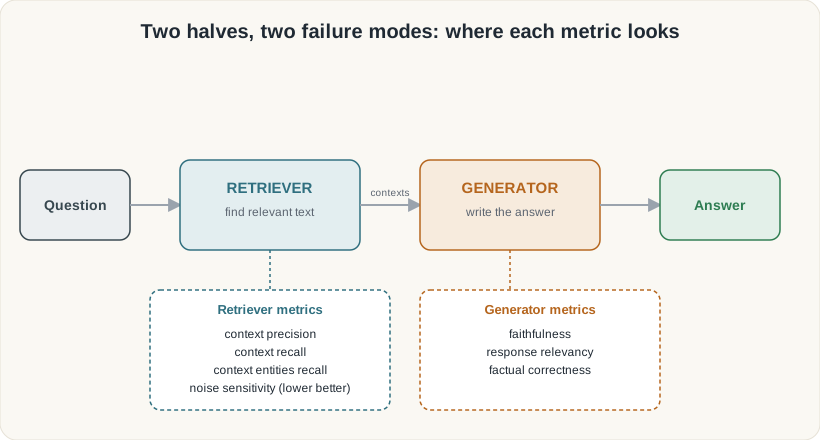
Each half can fail independently. Modules 7–9 will measure both halves with separate metrics.
Putting it together · 1 of 2
When RAG helps — and when it doesn't
- Facts live in a specific document corpus
- Information changes over time (prices, news)
- You need to cite your sources
- Private data must stay private (on-prem)
- The task is pure reasoning (math, logic puzzles)
- General world-knowledge questions the model already knows
- Corpus is too noisy — bad retrieval degrades answers
RAG is only as good as its retriever. If the retriever fetches irrelevant passages, the generator will produce a well-written but wrong answer. Retrieval quality is the #1 lever.
Does adding a reranker improve our precious-metals RAG system — and by how much, across which metrics?
Putting it together · 2 of 2
Your 12-module roadmap
| Module | Topic | New capability |
|---|---|---|
| 01 | What is RAG? ← you are here | Concepts + intuition |
| 02 | Embeddings & meaning | Turn text into vectors |
| 03 | Similarity & vector search | Find nearest neighbors in Qdrant |
| 04 | Chunking & the corpus | Split 8-file metals knowledge base |
| 05 | First real RAG | Cloud LLM + prompt-stuffing answers |
| 06 | Why evaluate? | RAGAS setup + evaluation mindset |
| 07–08 | Retriever metrics | Precision, recall, entity recall, noise |
| 09 | Generator metrics | Faithfulness, relevancy, factual correctness |
| 10 | Reranking | Cohere rerank-v3.5 |
| 11 | RAG → Agent | LangGraph ReAct agent + agent metrics |
| 12 | Capstone | Full pipeline assembly + MDD comparison |
Summary
What you learned in Module 01
The problem
- LLMs have a frozen knowledge cutoff
- They confabulate when they don't know
- Private data and live facts are inaccessible
The RAG idea
- Retrieve → Select → Augment → Generate
- In-context learning: read before answering
- Two halves: retriever and generator
What's next
- RAG needs good retrieval to work
- Module 02 builds the retrieval foundation: embeddings
01_what_is_rag.ipynb in Jupyter Lab and step through the cells to reinforce these ideas with interactive examples.