ASDRP · Agentic RAG Track · Module 05
Stack Migration +
First Real RAG
Swap the local embedder for cloud Ollama and build your first complete end-to-end RAG answer.
Retrieve → Augment Prompt → Generate Grounded Answer
ChatOllama
OllamaEmbeddings
QdrantVectorStore
find_dotenv
Built by mui-group @ ASDRP· Advanced Student Directed Research Program
What we'll cover
Contents
1
The Migration
- Why leave the local embedder
- Embedding space consistency
- The shared
tutorials/.env find_dotenv()pattern
2
Building the Stack
ChatOllama— generator LLMOllamaEmbeddings— embedder- Corpus → chunks → Qdrant
- In-memory vector store
3
First RAG Answer
RAG_PROMPTtemplaterag_answer()function- Retrieve → select top-3 → generate
- Grounding vs correctness
The full picture
The RAG Architecture — completed in M05
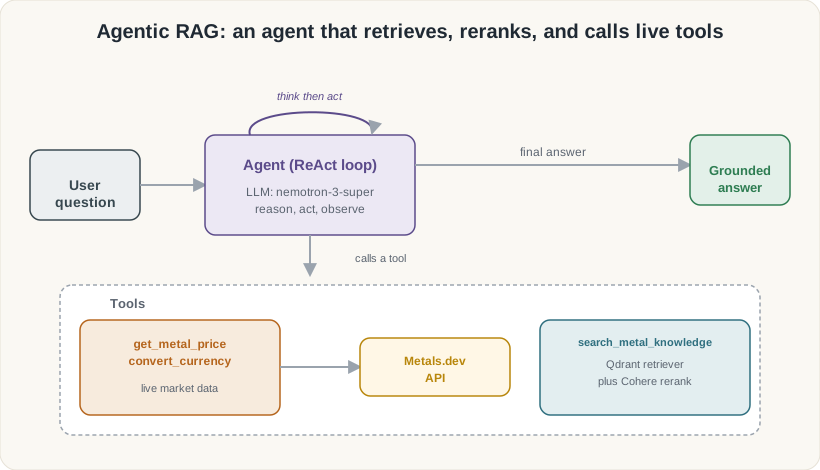
Modules 01–04 built retrieval. Module 05 completes the loop: cloud embedder + Augment → Generate.
Track 1 · The Migration
Why leave the local embedder?
Embedding space consistency
Cosine similarity only works when query and corpus vectors live in the same space. The index model must equal the query model — always.
Cosine similarity only works when query and corpus vectors live in the same space. The index model must equal the query model — always.
RAGAS alignment
RAGAS (Module 06) scores retrieval using its own embedding calls. It must match your retrieval embedder or the scores are meaningless.
RAGAS (Module 06) scores retrieval using its own embedding calls. It must match your retrieval embedder or the scores are meaningless.
Representation quality
qwen3-embedding:0.6b produces better representations for financial/commodity text than a 384-dim general model.
Track 1 · Shared keys
The shared tutorials/.env pattern
One file. All twelve modules.
Create
Create
tutorials/.env once. Every module notebook calls
load_dotenv(find_dotenv()), which walks up the directory
tree and resolves to that single shared file.
Already gitignored.
tutorials/.gitignore ignores .env at the
parent level. No per-module gitignore line needed — and no risk of
accidentally committing real keys.
⚠ NEVER hard-code a key in notebook source. Rotate any key that leaks immediately.
import os
from dotenv import load_dotenv, find_dotenv

# Walks UP → finds tutorials/.env automatically
load_dotenv(find_dotenv())

HAVE_KEYS = bool(os.environ.get("OLLAMA_API_KEY"))

if not HAVE_KEYS:
    print("No key found — using frozen/ results.")
tutorials/.env format:
OLLAMA_API_KEY=<your cloud Ollama key>
# COHERE_API_KEY=  ← added in Module 10
# METALS_API_KEY=  ← added in Module 11
Track 2 · Building the stack
Cloud Ollama LLM + Embedder
from langchain_ollama import ChatOllama, OllamaEmbeddings

os.environ.setdefault("OLLAMA_API_BASE", "http://localhost:11434")

chat_llm = ChatOllama(
    model="nemotron-3-super:cloud",
    base_url=os.environ["OLLAMA_API_BASE"],
    temperature=0.0,          # deterministic answers for reproducibility
)
lc_embeddings = OllamaEmbeddings(
    model="qwen3-embedding:0.6b",
    base_url=os.environ["OLLAMA_API_BASE"],
)
| Object | Model | Role |
|---|---|---|
chat_llm | nemotron-3-super:cloud | Generates the grounded answer |
lc_embeddings | qwen3-embedding:0.6b | Encodes corpus chunks and queries |
⚠ Caution — model names are cloud-specific. The
:cloud suffix routes through the cloud relay. Substitute locally-served names if running a local daemon.
Track 2 · Indexing
Corpus → chunks → Qdrant :memory:
from langchain_text_splitters import RecursiveCharacterTextSplitter
from langchain_qdrant import QdrantVectorStore
from langchain_core.documents import Document
from pathlib import Path

raw_docs = [{"source": p.name, "page_content": p.read_text()}
            for p in sorted(Path("corpus").glob("*.md"))]  # 8 files

splitter = RecursiveCharacterTextSplitter(chunk_size=500, chunk_overlap=60)
lc_docs  = [Document(page_content=piece, metadata={"source": d["source"]})
            for d in raw_docs
            for piece in splitter.split_text(d["page_content"])]

vector_store = QdrantVectorStore.from_documents(
    lc_docs, embedding=lc_embeddings,
    location=":memory:", collection_name="metals_kb")
⚠ Cost —
from_documents sends one embedding call per chunk (~50–80 calls total). Small, but it does consume quota. Skip if no key — use frozen output.
Track 3 · First RAG answer
The RAG_PROMPT template — why it matters
Constraint drives grounding
Telling the model to answer only from the context passages — and to say "I don't know" when the answer isn't there — is what separates RAG from pure generation.
Telling the model to answer only from the context passages — and to say "I don't know" when the answer isn't there — is what separates RAG from pure generation.
If context is wrong, answer is wrong
Grounding constrains the LLM, but doesn't fix bad retrieval. Module 09 measures Faithfulness — how strictly the answer stays in the context.
Grounding constrains the LLM, but doesn't fix bad retrieval. Module 09 measures Faithfulness — how strictly the answer stays in the context.
from langchain_core.prompts import ChatPromptTemplate

RAG_PROMPT = ChatPromptTemplate.from_template(
    "You are a precise metals-markets tutor. "
    "Answer using ONLY the context passages. "
    "If the context does not contain the answer, "
    "say you do not know.\n\n"
    "Context:\n{context}\n\n"
    "Question: {question}\n"
    "Answer:"
)
Track 3 · First RAG answer
rag_answer() — retrieve → select → generate
def rag_answer(question: str, k: int = 10, top_n: int = 3) -> dict:
    retriever  = vector_store.as_retriever(search_kwargs={"k": k})
    candidates = [d.page_content for d in retriever.invoke(question)]
    # Module 10 replaces this slice with a Cohere rerank call:
    contexts   = candidates[:top_n]
    block      = "\n\n".join(f"[{i}] {c}" for i, c in enumerate(contexts, 1))
    response   = chat_llm.invoke(
        RAG_PROMPT.format_messages(context=block, question=question)
    ).content.strip()
    return {"response": response, "retrieved_contexts": contexts}
k=10 retrieve 10 candidates from Qdrant
top_n=3 take first 3 (no rerank yet)
⚠ RAG is retrieval-limited. If the right chunk isn't in the top-k, no generator can fix it. Module 07 measures retrieval precision so you can tune k empirically.
Track 3 · Safety net
Frozen fallback — follow along without a key
import json

if HAVE_KEYS:
    result = rag_answer("What factors drive gold prices higher?")
else:
    with open("frozen/rag_answer.json") as fh:
        result = json.load(fh)
    print("(using cached illustrative result — "
          "set OLLAMA_API_KEY in tutorials/.env to run live)")

print(result["response"])
frozen/rag_answer.json is hand-authored, clearly labelled as illustrative, and has the same JSON shape as a live result —
{"response": "...", "retrieved_contexts": [...]}. It lets you read sensible output and keep going.
Always know when the number lies
Three cautions for Module 05
⚠ Grounding ≠ correctness.
Instructing the LLM to stay in-context reduces hallucination but does not eliminate it. If retrieved passages are inaccurate, the answer can still be wrong. Module 09 measures this gap with Faithfulness and Factual Correctness.
⚠ RAG quality is retrieval-limited.
If the right passage is not in the top-k candidates, even a perfect generator cannot produce a correct answer. The parameter k is critical — too small misses passages, too large floods the prompt. Module 07 measures retrieval precision to tune it.
⚠ Cost note.
Every
rag_answer() call sends one embedding request + one chat-completion request. Indexing sends ~50–80 embedding calls. Use the frozen fallback if you are on a free-tier key and want to preserve quota.
Recap
Summary
1
The Migration
- Local → cloud embedder for quality + RAGAS alignment
- Shared
tutorials/.envviafind_dotenv() - Frozen fallback for keyless students
2
Building the Stack
ChatOllama+OllamaEmbeddings- Corpus chunked into Qdrant
:memory: - Same stack as the capstone — from here forward
3
First RAG Answer
RAG_PROMPTconstrains the LLM to contextrag_answer(): retrieve → top-3 → generate- Grounding ≠ correctness — metrics come in M06–M09
Run the notebook: 05_first_real_rag.ipynb · Next: Module 06 — Why Evaluate? + RAGAS Setup