ASDRP · Agentic RAG Track · Module 07
Retriever Metrics
Score your retriever with two complementary RAGAS metrics — context precision and context recall — and learn to read what each number is really telling you.
What we'll cover
Contents
Concept: the two metrics
- Precision vs Recall intuition
- The fishing analogy
- Why they pull in opposite directions
Code: evaluate() + single-sample debug
- RAGAS model setup (judge + embeddings)
- Building the EvaluationDataset
- evaluate() over 8 golden questions
- single_turn_ascore() for one sample
Cautions & next steps
- When precision misleads
- When recall grades your test set
- LLM-judge variance
- Preview: Module 08 adds entity recall + noise
Retriever evaluation
Why two metrics for one retriever?
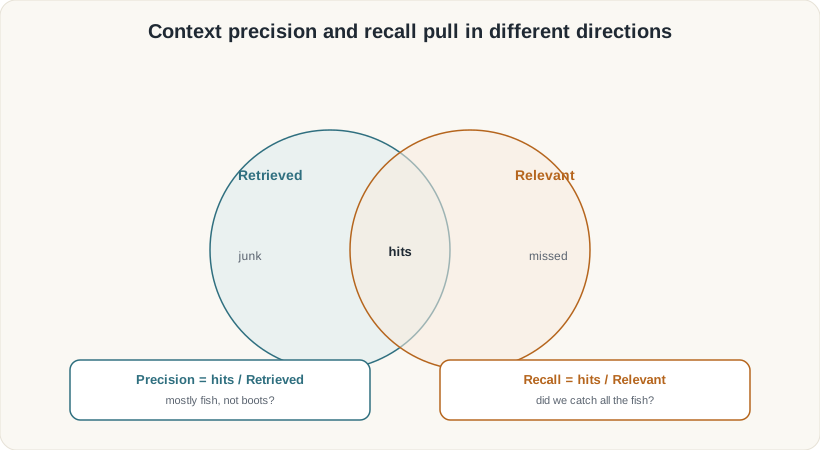
Of all the chunks you returned, how many were actually useful — and were the useful ones near the top?
Did the retriever surface every chunk of evidence needed to answer this question fully?
These two metrics trade off against each other. Retrieving fewer chunks lifts precision but hurts recall. Retrieving many chunks improves recall but lets irrelevant noise in.
Intuition
The fishing analogy
"Did I mostly catch fish, not old boots?"
High precision = most returned chunks were relevant. Score drops if garbage chunks fill the top slots.
"Did I catch all the fish that were in the lake?"
High recall = every useful passage was retrieved. Score drops if you left important evidence behind.
Both numbers are needed. A system with 0.9 precision and 0.4 recall is broken in a different, equally serious way from one with 0.4 precision and 0.9 recall.
LLMContextPrecisionWithReference
How RAGAS computes context precision
from ragas.metrics import LLMContextPrecisionWithReference

# RAGAS sends each (question, chunk, reference) triple to the judge LLM
# and asks: "Is this chunk useful for answering the question given this reference?"
# It weights the verdicts by position — top-ranked relevant chunks score higher.
metric = LLMContextPrecisionWithReference(llm=judge_llm)
user_input— the questionretrieved_contexts— list of chunks the retriever returnedreference— the gold-standard reference answer
0 → every top slot is irrelevant | 1 → relevant chunks dominate and rank first.
The position weighting means a relevant chunk at rank 1 counts more than the same chunk at rank 5.
LLMContextRecall
How RAGAS computes context recall
from ragas.metrics import LLMContextRecall

# RAGAS decomposes the reference answer into individual statements,
# then checks each statement: "Is there a retrieved chunk that supports this?"
# Recall = fraction of reference statements that are covered.
metric = LLMContextRecall(llm=judge_llm)
user_input— the questionretrieved_contexts— list of chunks the retriever returnedreference— the gold-standard reference answer (decomposed into statements)
0 → no reference statement was supported by retrieved chunks | 1 → every reference statement was found.
This grades coverage, not ranking.
Comparison
Precision vs Recall — side by side
| Property | LLMContextPrecisionWithReference | LLMContextRecall |
|---|---|---|
| Question it answers | "Are retrieved chunks relevant and well-ordered?" | "Did we retrieve all the needed information?" |
| Compares against | Reference answer (for relevance verdict) | Reference answer statements (coverage check) |
| Sensitive to ranking? | Yes — position-weighted | No — only cares about presence, not order |
| Hurt by too few chunks? | No (fewer is often better) | Yes — missed evidence lowers recall |
| Hurt by noisy chunks? | Yes — irrelevant chunks at top = low score | No — extra noise is ignored |
Step 0 · Setup
Environment setup: shared .env + RAGAS stub
import os
from dotenv import load_dotenv, find_dotenv
load_dotenv(find_dotenv())          # resolves to tutorials/.env
HAVE_KEYS = bool(os.environ.get("OLLAMA_API_KEY"))

# RAGAS 0.4.3 import stub — must come BEFORE importing ragas
import sys, types
_vx = types.ModuleType("langchain_community.chat_models.vertexai")
class ChatVertexAI: pass
_vx.ChatVertexAI = ChatVertexAI
sys.modules["langchain_community.chat_models.vertexai"] = _vx

import nest_asyncio; nest_asyncio.apply()   # RAGAS uses asyncio; notebooks already run a loop
evaluate() call sends each (question × chunk) pair to the judge LLM. With 8 golden questions and k=10 chunks each, that is ~80 LLM calls per metric. Keep k small during development.
Step 1 · RAGAS models
Wiring the judge LLM + embeddings
import litellm
from ragas.llms import llm_factory
from ragas.embeddings.base import embedding_factory

JUDGE_MODEL     = "ollama_chat/gemma4:31b-cloud"
EMBEDDING_MODEL = "ollama/qwen3-embedding:0.6b"

judge_llm       = llm_factory(JUDGE_MODEL, provider="litellm",
                               client=litellm.completion, temperature=0.0)
ragas_embeddings= embedding_factory("litellm", model=EMBEDDING_MODEL,
                                     api_base=os.environ["OLLAMA_API_BASE"])
The generator writes answers; the judge grades them. Using the same model for both creates a conflict of interest — it tends to rate its own outputs highly.
gemma4:31b-cloud is a deliberate different model at temperature 0.
Step 2 · Dataset
Building the EvaluationDataset from the golden set
import json
from ragas.dataset_schema import SingleTurnSample, EvaluationDataset

golden = json.load(open("golden_questions.json"))

samples = [
    SingleTurnSample(
        user_input=g["question"],
        retrieved_contexts=rag_result["retrieved_contexts"],
        response=rag_result["response"],
        reference=g["reference"],
    )
    for g in golden
    for rag_result in [rag_answer(g["question"])]
]

eval_dataset = EvaluationDataset(samples=samples)
print(f"Dataset: {len(samples)} samples")
Each SingleTurnSample bundles everything the metrics need: the question, what the retriever fetched, the generated answer, and the reference answer to grade against.
Step 3 · Evaluate
Running evaluate() over the full dataset
from ragas import evaluate
from ragas.metrics import LLMContextPrecisionWithReference, LLMContextRecall

retriever_metrics = [
    LLMContextPrecisionWithReference(),
    LLMContextRecall(),
]

results = evaluate(
    dataset=eval_dataset,
    metrics=retriever_metrics,
    llm=judge_llm,
    embeddings=ragas_embeddings,
)

df = results.to_pandas()
print(df[["user_input", "context_precision", "context_recall"]])
context_precision ≈ 0.78 | context_recall ≈ 0.71
Step 4 · Single-sample debug
Debugging one sample with single_turn_ascore()
import asyncio

# Pick a sample that scored low on recall and inspect it
sample = samples[6]   # the multi-hop silver question

precision_score = asyncio.run(
    LLMContextPrecisionWithReference(llm=judge_llm).single_turn_ascore(sample)
)
recall_score = asyncio.run(
    LLMContextRecall(llm=judge_llm).single_turn_ascore(sample)
)

print(f"Question: {sample.user_input}")
print(f"Precision: {precision_score:.3f}   Recall: {recall_score:.3f}")
print(f"Retrieved {len(sample.retrieved_contexts)} chunks")
Watch out
Three things that make these numbers lie
Every chunk you returned was relevant, but you missed half of what you needed. This looks like success on a precision dashboard but the answer is still incomplete.
Recall is measured against the
reference you wrote. If your reference is vague or incomplete, recall will look worse than the retriever really is. The metric is only as good as the golden set.
RAGAS uses an LLM to decide relevance. Re-running the same dataset can produce slightly different scores. Report means over multiple runs when you need precise comparisons; don't read too much into a 0.02 difference.
Summary
What you built in Module 07
Two complementary metrics
- Precision: relevant chunks ranked high
- Recall: all needed evidence retrieved
- They trade off — you need both
Live evaluation code
- RAGAS judge + embeddings wired via LiteLLM
evaluate()over 8 golden questionssingle_turn_ascore()for sample-level debug
Honest limitations
- Precision hides recall gaps
- Recall grades the golden set too
- LLM-judge variance — report means
Run the notebook: 07_retriever_metrics.ipynb · Next: Module 08 — More Retriever Metrics (ContextEntityRecall + NoiseSensitivity)