ASDRP · Agentic RAG Track · Module 08
More Retriever Metrics
Score whether retrieved passages capture key named entities — and whether irrelevant passages mislead the generator.
What we'll cover
Contents
Context Entity Recall
- What named entities are
- How the LLM judge extracts them
- The recall formula
- Run
ContextEntityRecall
Noise Sensitivity
- The inverted-scale trap ⚠
- How irrelevant passages mislead
- Run
NoiseSensitivity - Single-sample debug pattern
Evaluate & Interpret
- Full
evaluate()run - Reading the results table
- Connecting to Module 07
- What to fix when scores are bad
Track 1 · Context Entity Recall
Did the retriever catch the key named entities?
Precision/Recall (Module 07) score whole passages. Entity Recall zooms in: does the retrieved context contain the specific named things the reference answer mentions?
- LLM judge extracts named entities from the reference answer
- Checks how many appear in the retrieved context
- For metals: gold, silver, troy ounce, LBMA, contango, PGM…
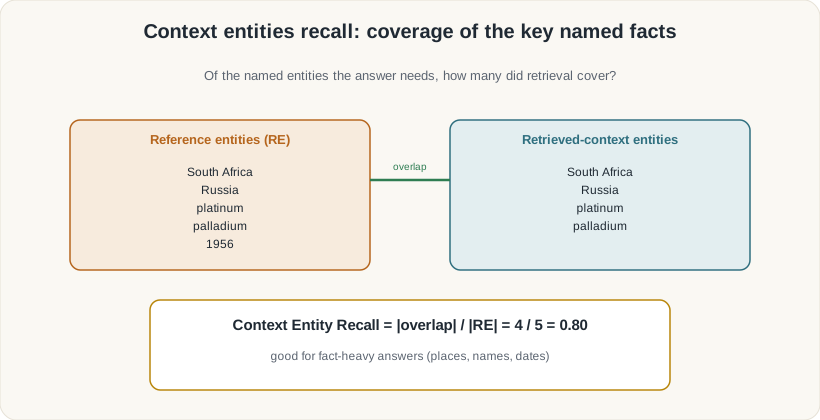
Track 1 · Context Entity Recall
Running ContextEntityRecall
from ragas.metrics import ContextEntityRecall
from ragas import evaluate

# metrics list contains ONLY the two new metrics for this module
metrics = [ContextEntityRecall()]

results = evaluate(
    dataset=eval_dataset,   # EvaluationDataset with 8 golden samples
    metrics=metrics,
    llm=judge_llm,          # LLM judge extracts entities from reference
    embeddings=ragas_embeddings,
)
print(results.to_pandas()[["user_input", "context_entity_recall"]])import asyncio
score = asyncio.run(
ContextEntityRecall(llm=judge_llm).single_turn_ascore(samples[3])
)
print(f"Entity recall for Q4: {score:.3f}")Track 2 · Noise Sensitivity
How often does irrelevant context mislead the generator?
Even a precise retriever can return a few irrelevant passages. NoiseSensitivity measures how often the generator makes incorrect claims that trace back to those noisy passages.
Lower NoiseSensitivity is better. A score of 0 means the generator was never misled. A score of 1 means every incorrect claim came from noisy context. Do NOT celebrate a high score here.
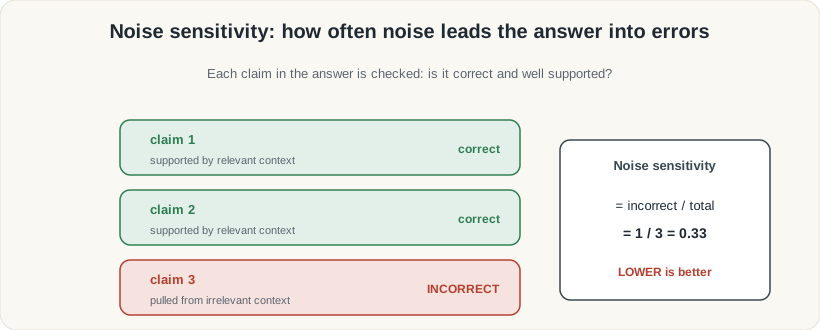
Track 2 · Noise Sensitivity
What the metric actually measures
The judge compares the generated answer to the reference and finds any claims that are wrong or unsupported.
For each incorrect claim, the judge checks: did this error come from an irrelevant (noisy) retrieved passage?
NoiseSensitivity = errors_from_noise / total_statements_in_answerA retriever that returns only tight, relevant passages should keep this near 0.
k (fewer retrieved chunks) or add reranking (Module 10) to filter noise before the generator sees it.
Track 2 · Noise Sensitivity
Running NoiseSensitivity
from ragas.metrics import NoiseSensitivity

# NoiseSensitivity: LOWER is better — it measures how often the
# generator is misled by irrelevant retrieved passages.
metrics = [NoiseSensitivity()]

results = evaluate(
    dataset=eval_dataset,
    metrics=metrics,
    llm=judge_llm,
    embeddings=ragas_embeddings,
)
df = results.to_pandas()
print(df[["user_input", "noise_sensitivity_relevant"]])

# ⚠ A score of 0.18 is GOOD. A score of 0.80 is BAD.noise_sensitivity_relevant. When you sort the table, sort ascending to put the best-performing questions at the top.
Track 3 · Evaluate & Interpret
Running both metrics together
from ragas.metrics import ContextEntityRecall, NoiseSensitivity
from ragas import evaluate

metrics = [
    ContextEntityRecall(),
    NoiseSensitivity(),      # LOWER is better
]

results = evaluate(
    dataset=eval_dataset,
    metrics=metrics,
    llm=judge_llm,
    embeddings=ragas_embeddings,
)
df = results.to_pandas()
print(df[["user_input",
          "context_entity_recall",
          "noise_sensitivity_relevant"]])
Track 3 · Evaluate & Interpret
How to read the results — the direction matters
| Metric | Good score | Scale direction | What to fix when bad |
|---|---|---|---|
context_entity_recall |
High (→ 1.0) | ↑ Higher is better | Retriever missing entity-rich chunks; try larger k or better chunking |
noise_sensitivity_relevant |
Low (→ 0) | ↓ Lower is better ⚠ | Retriever returning noisy passages; reduce k or add reranking (Module 10) |
context_precision (M07) |
High (→ 1.0) | ↑ Higher is better | Too many irrelevant chunks returned |
context_recall (M07) |
High (→ 1.0) | ↑ Higher is better | Key information missing from retrieval |
Track 3 · Evaluate & Interpret
How these metrics complement Module 07
Did the retriever return the right passages? Were any key passages missed? Operates at the passage level.
Did those passages contain the specific named entities the answer needs? Did irrelevant passages slip through and mislead the generator?
Together, all four metrics give a complete retriever health check:
- Precision → are returned chunks relevant?
- Recall → are needed chunks present?
- Entity Recall → are the right facts present?
- Noise Sensitivity → is the generator being misled?
Wrap-up
Summary
Context Entity Recall
- Measures named-entity coverage in retrieved context
- LLM judge extracts entities from the reference answer
- Higher → better entity coverage
- Catches retrieval gaps invisible to passage-level metrics
Noise Sensitivity ⚠
- LOWER is better — measures how often noise misleads the generator
- High score = retriever returning too much irrelevant context
- Fix: reduce
kor add reranking (Module 10) - The one inverted-scale metric in the retriever suite
What's next
- Module 09 adds generator metrics: Faithfulness, ResponseRelevancy, FactualCorrectness
- Module 10 adds Cohere reranking to cut noise
- Module 12 assembles all metrics into the full MDD loop
Run the notebook: 08_more_retriever_metrics.ipynb