ASDRP · Agentic RAG Track · Module 09
Generator Metrics
+ LLM-as-Judge
Score the answer, not just the retrieval — and understand the judge behind every score.
What we'll cover
Contents
Faithfulness
- Claim decomposition
- Grounding in context
- Score formula
- Hallucination detection
Relevancy & Correctness
- Response Relevancy
- Back-question technique
- Factual Correctness F1
- Precision vs Recall modes
LLM-as-Judge
- How judge scoring works
- Verbosity & position bias
- Self-preference
- Mitigation strategies
Motivation
Retriever metrics aren't enough
Did the right passages end up in the context window?
Did the model turn those passages into a good answer?
A retriever can be perfect and the generator still hallucinate.
A generator can be fluent and still miss the point entirely.
You need both sides. High retriever scores with low generator scores means your model is not using the context. High generator scores with low retriever scores is unlikely — garbage in, garbage out.
Generator Metric 1
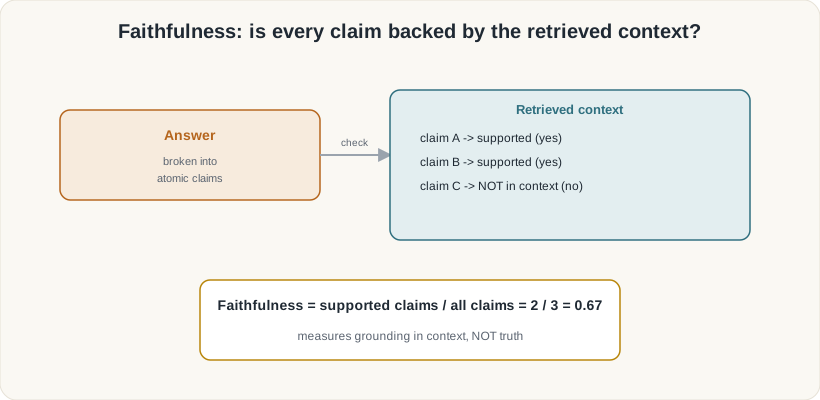
Faithfulness — does every claim have a source?
The judge LLM:
- Decomposes the answer into atomic statements
- Checks each statement against the retrieved contexts
- Returns the fraction that are grounded
Score 0.6 — 40% of claims are hallucinated
Faithfulness = 1.0 still allows wrong answers if the retrieved passages themselves contain errors. It only checks consistency with context, not truth.
Generator Metric 1 — Code
Running Faithfulness
from ragas import evaluate
from ragas.metrics import Faithfulness

results = evaluate(
    dataset=eval_dataset,
    metrics=[Faithfulness()],
    llm=judge_llm,          # temperature=0 for deterministic scores
    embeddings=ragas_embeddings,
)
df = results.to_pandas()
print(df[["user_input", "faithfulness"]])
# faithfulness: 0.0 – 1.0 (higher is better)score = await Faithfulness(llm=judge_llm).single_turn_ascore(samples[0])
print(score) # e.g. 0.88nest_asyncio.apply() must be called first so await works inside a Jupyter event loop.
Generator Metric 2
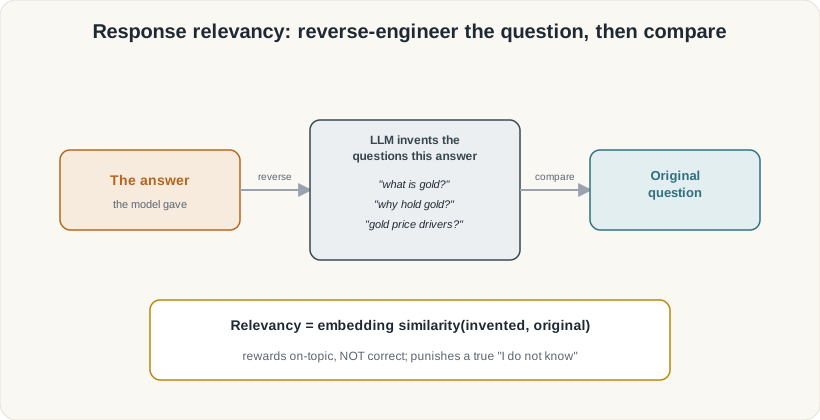
Response Relevancy — is the answer on-topic?
The judge generates n synthetic questions that the answer could be answering, then measures how similar they are to the original question using embeddings.
Low score — answer drifted or addressed a different question
Generator Metric 3
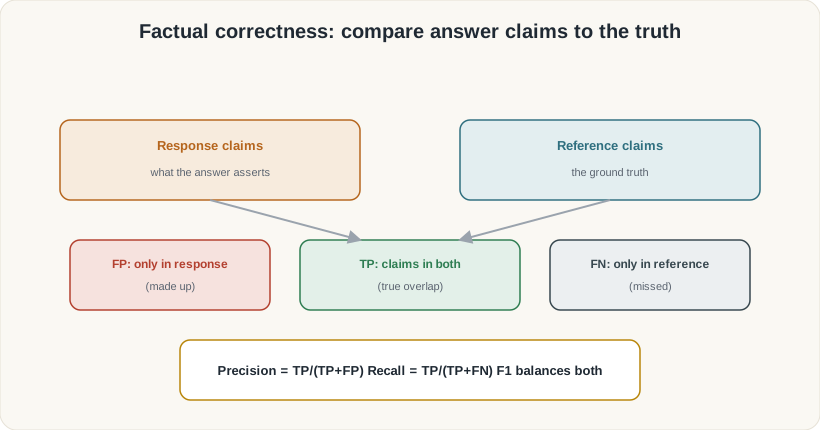
Factual Correctness — does it match the reference?
| Mode | Question asked |
|---|---|
precision | Are the answer's claims correct? |
recall | Were all reference points covered? |
f1 (default) | Harmonic mean of both |
Faithfulness compares answer ↔ context.
Factual Correctness compares answer ↔ golden reference.
Only this metric catches errors the context already contained.
Generator Metric 3 — Code
Precision, Recall, and F1 modes
from ragas.metrics import FactualCorrectness

# Default: F1 (harmonic mean of precision and recall)
results_f1 = evaluate(
    dataset=eval_dataset,
    metrics=[FactualCorrectness()],
    llm=judge_llm, embeddings=ragas_embeddings,
)

# Precision only — are the answer's claims accurate?
fc_precision = FactualCorrectness(llm=judge_llm, mode="precision")

# Recall only — did the answer cover all reference points?
fc_recall = FactualCorrectness(llm=judge_llm, mode="recall")

scores_p = await fc_precision.single_turn_ascore(samples[0])
scores_r = await fc_recall.single_turn_ascore(samples[0])
print(f"Precision: {scores_p:.2f} Recall: {scores_r:.2f}")Track 3 — LLM-as-Judge
How judge scoring actually works
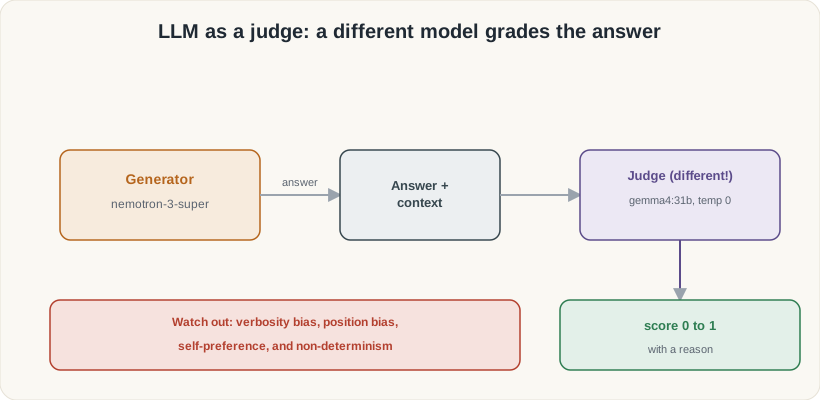
Every RAGAS generator metric sends a structured prompt to a judge LLM — a second model that reads the question, context, answer, and optional reference, then returns a score.
NLP overlap metrics (ROUGE, BLEU) reward exact wording, not meaning. A judge LLM understands paraphrase, entailment, and implication.
temperature=0A deterministic judge gives reproducible scores across re-runs. Never use a high-temperature judge for evaluation.
Track 3 — LLM-as-Judge
Known biases — and how to guard against them
| Bias | What happens | Mitigation |
|---|---|---|
| Verbosity bias | Judge prefers longer, more elaborate answers even if they contain errors | Evaluate concise and verbose answers on separate benchmarks; penalise hallucination explicitly |
| Position bias | In A/B comparisons the judge favours whichever candidate appears first | Randomise candidate order; average scores from both orderings |
| Self-preference | A model rates its own outputs higher than outputs from other models | Always use a different model as judge and generator |
In this track: generator =
nemotron-3-super:cloud (T=0.3),
judge = gemma4:31b-cloud (T=0.0).
Different models, different temperatures — by design.
Putting it all together
Running all generator metrics at once
from ragas import evaluate
from ragas.metrics import Faithfulness, ResponseRelevancy, FactualCorrectness

results = evaluate(
    dataset=eval_dataset,
    metrics=[
        Faithfulness(),
        ResponseRelevancy(),
        FactualCorrectness(),
    ],
    llm=judge_llm,
    embeddings=ragas_embeddings,
)

df = results.to_pandas()
print(df[["user_input","faithfulness","answer_relevancy","factual_correctness"]])faithfulness ≈ 0.88 · answer_relevancy ≈ 0.82 · factual_correctness ≈ 0.69
Interpretation
Reading your generator scores
| Metric | Compares | Typical failure | Higher is better? |
|---|---|---|---|
| Faithfulness | Answer ↔ Context | Hallucination (claims not in context) | Yes |
| Response Relevancy | Answer ↔ Question | Answer drifts off-topic | Yes |
| Factual Correctness | Answer ↔ Reference | Wrong facts or missing key points | Yes |
Your retriever returned passages that were already wrong. Fix the corpus or retriever, not the generator.
Model accurately quotes context but ignores the actual question. Revisit your RAG prompt template.
Recap
Summary
Faithfulness
- Decomposes answer into claims
- Checks each claim vs context
- Detects hallucination
- Does NOT check vs truth
Relevancy & Correctness
- Response Relevancy: back-question cosine
- FactualCorrectness: answer vs golden ref
- F1, precision, recall modes
- Faithfulness ≠ Correctness
LLM-as-Judge
- Judge at temperature=0
- Generator ≠ judge (self-preference)
- Verbosity & position bias
- This module OWNS the concept
Run the notebook: 09_generator_metrics.ipynb · Next: Module 10 — Reranking (Cohere rerank-v3.5, before/after lift)